

Table of Contents
- The Real Difference Between a Flooring Consultation and Online Shopping
- Online Shopping vs Local Flooring Store: A Total Cost Comparison
- Why Flooring Samples Before Buying Matter More Than Photos
- Questions to Ask a Flooring Contractor Before You Commit
- How to Compare Flooring Installation Quotes Without Getting Burned
- How to Choose a Flooring Supplier for Your Project Type
- When Online Shopping Makes Sense and When a Flooring Consultation Wins
- Frequently Asked Questions
Last Updated: October 15, 2026
The Real Difference Between a Flooring Consultation and Online Shopping
Choosing between a professional flooring consultation and online shopping comes down to one question: who absorbs the risk when something goes wrong? Online retailers hand you a box and a tracking number. A flooring expert walks your rooms, measures your subfloor, and stands behind the material when it’s installed.
Online shopping wins on browsing speed and upfront price. The Federal Trade Commission’s guidance on mail, internet, and telephone order merchandise is clear that sellers must ship by the date promised or offer a refund, but it says nothing about who pays when a pallet arrives with crushed edges or the dye lot doesn’t match your hallway.
Below, we break down total cost, samples, contractor questions, quote comparison, and supplier selection so you can pick the right channel for your project.
Online Shopping vs Local Flooring Store: A Total Cost Comparison
The sticker price online is not the price you pay. A local flooring store quote bundles services that online sellers bill separately or leave to you, so a true total-cost comparison runs the whole project, line by line.
The Cost Lines Most Buyers Forget
A cart total and a showroom quote cover different scopes. Here is what a realistic project budget must account for:
- Material price. Online listings are usually lower per square foot because there is no showroom, local inventory, or sales staff, the one line where online wins cleanly.
- Freight and delivery. Online flooring is heavy. Freight is often quoted separately, and liftgate service plus inside placement are frequent add-ons or not offered. A local store typically quotes delivery as part of the job or includes it above a threshold.
- Samples. Mail-order samples may be free or a few dollars each, but arrive as small chips that do not show a full plank’s grain. Showroom samples are usually free, take-home, and full-size.
- Waste and overage. Every installation needs extra material for cuts, waste, and future repairs, commonly 5-10% for a simple rectangular room, more for angles or diagonal layouts. Order too little online and you pay a second freight charge plus the risk of a different dye lot.
A Simple Way to Compare
Do not compare the material price. Compare the delivered, installed, and returnable cost. Ask each channel for a written number covering material, freight, delivery placement, samples, waste allowance, consumables, installation, and the return policy. The lower material price is not always the lower total, the gap shows up in lines that were never quoted.
| Cost Factor | Online Order | Local Flooring Store |
|---|---|---|
| Material price | Lower upfront | Higher upfront |
| Freight and delivery | Often added at checkout; liftgate and inside placement extra | Quoted or included |
| Samples | Mail-order, small chips, may cost per sample | In showroom, full-size, take-home |
| Waste allowance | You calculate it | Supplier advises 5-10%+ |
| Consumables | Separate purchase | Often itemized in quote |
| Subfloor prep | Your responsibility | Coordinated |
| Damaged or missing material | Claim process, you reorder | Replaced through supplier |
| Returns | Unopened only, you pay freight, restocking fee common | Handled at counter |
| Dye-lot match on reorder | Not guaranteed | Often pulled from same lot |
| Warranty support | Call center | Named contact |
The most common mistake we see is ordering the exact square footage a room measures. Add 5-10% for cuts, waste, and future repairs. Running short mid-install means a second order, and a second order may come from a different dye lot.
Compare the delivered, installed, and returnable cost, not the sticker price. The channel that looks cheaper in the cart is often the more expensive one by the time the last plank is down.
Why Flooring Samples Before Buying Matter More Than Photos
Flooring samples before buying are not a formality. Screen calibration, studio lighting, and photo editing distort color, and a hardwood that reads warm on your phone can look gray in a north-facing bedroom.
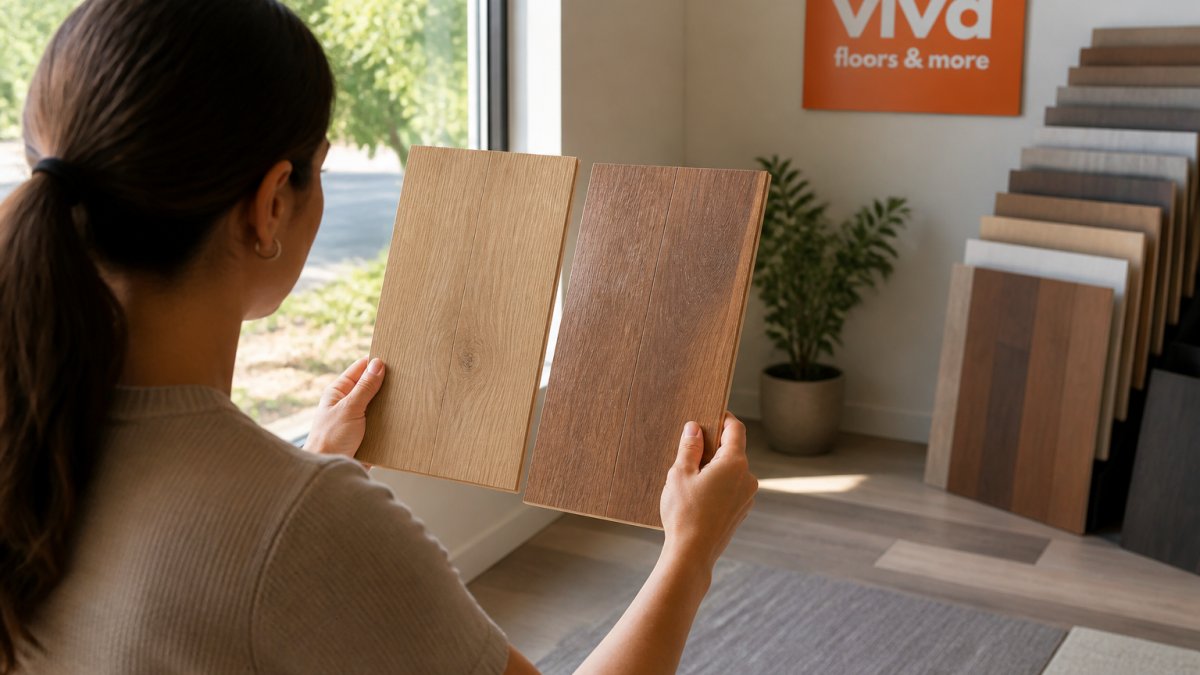
Take samples home. Look at them at noon, at dusk, and under your actual lamps.
Lighting changes a floor more than the finish does. A sample viewed only under showroom fluorescents tells you little about how the same plank behaves in a room with west-facing windows.
Questions to Ask a Flooring Contractor Before You Commit
The right questions to ask a flooring contractor separate a professional from a crew with a truck. Ask before you sign, not after demolition starts.
- Who measures the rooms, and is that measurement guaranteed?
- How will you handle subfloor prep, and is it in the written quote?
- What is the acclimation time for this material in my home?
- Who files the warranty claim if a plank fails in year two?
The U.S. Environmental Protection Agency’s guidance on indoor air quality and flooring materials is worth a look if anyone in the household has asthma or chemical sensitivity, since adhesives and finishes vary widely in emission profiles.
How to Compare Flooring Installation Quotes Without Getting Burned
Comparing flooring installation quotes means comparing scope, not totals. Two quotes with the same bottom line can cover wildly different work.
Demand an itemized quote listing material, underlayment, adhesive, transitions, removal and disposal of the old floor, subfloor prep, and labor as separate lines.
Then compare exclusions. A low quote often excludes subfloor leveling, the most common surprise charge on a renovation.
Ask for the quote to name the exact product and dye lot, not just “luxury vinyl plank.” When the material is specified, you can verify it is the same product across every bid, and you have a paper trail if the wrong batch shows up on delivery day.
How to Choose a Flooring Supplier for Your Project Type
How to choose a flooring supplier depends on what you are building, and what is under the floor. A single-room refresh, a whole-home renovation, and a multi-unit build have different needs. The angle most guides skip is technical suitability: the product that looks perfect online can fail because of moisture, subfloor condition, or transitions. A supplier worth choosing helps you answer those questions before you buy.
Match the Supplier to the Project
- Single room, DIY. You want a supplier that sells to homeowners, stocks take-home samples, and answers installation questions. Ask whether they will review your subfloor photos before you order.
- Whole-home renovation. Availability and coordination matter more than a friendly showroom. Confirm bulk stock, delivery timing, and whether the supplier can hold a single dye lot across the order.
- New build or multi-unit. Volume and consistency drive the decision. Verify lead times and dye-lot matching in writing, because a backorder on one product can stall an entire schedule.
- Rental or commercial. Durability and warranty coverage for high-traffic areas decide it. Ask about wear layer thickness and warranty exclusions.
| Project Type | Priority | What to Verify |
|---|---|---|
| Single room, DIY | Guidance and samples | Take-home samples, install advice, subfloor review |
| Whole-home renovation | Availability and coordination | Bulk stock, delivery timing, single dye lot |
| New build or multi-unit | Volume and consistency | Dye lot matching, lead times |
| Rental or commercial | Durability and warranty | Wear layer, warranty terms |
The Technical Questions a Good Supplier Will Ask You
This is where a consultation earns its keep. Before recommending a product, a knowledgeable supplier should walk through the conditions that decide whether a floor will perform:
- Moisture. Concrete slabs wick moisture from below, and a slab that looks dry can still be too damp for solid hardwood or glue-down installation. A supplier should ask whether the slab is on or below grade and whether a moisture test has been done. A calcium chloride or in-situ probe test gives the emission rate, and the product’s spec sheet states the maximum it tolerates.
- Subfloor condition. Is the subfloor flat, level, and sound? Most manufacturers specify a flatness tolerance, commonly 1/8 inch in 6 feet or 3/16 inch in 10 feet, and a floor over a hump or dip will telegraph the defect. A supplier who asks for photos or a site visit is protecting you from a callback.
- Transitions and height. A thick floor under a door can leave no clearance for the swing, and a transition strip to an adjacent room may need a specific height. Confirm door clearances and transition options before you commit.
- Underlayment and compatibility. Some products require a specific underlayment, some have an attached pad, and some cannot be glued down. The wrong one can void the warranty. Ask what the manufacturer requires, not what is cheapest.
A flooring supplier that carries trusted brands, holds real inventory, and asks these technical questions solves the problem most buyers underestimate: waiting weeks for a product that was “in stock” online, only to find it does not suit the room it was meant for.
Before you buy, ask the supplier to confirm three things in writing: the moisture tolerance of the product, the subfloor flatness it requires, and the underlayment it needs. Those three answers prevent most installation failures, and most warranty disputes.
When Online Shopping Makes Sense and When a Flooring Consultation Wins
Online ordering makes sense for a small, simple job where you know the exact product, the room is a straightforward rectangle, and you are comfortable handling returns yourself.
A flooring consultation wins almost everywhere else.
Here is the decision framework we use:
- Small, simple, known product → online ordering can work
- Multiple rooms or unknown subfloor → get a consultation
- Pets, kids, or heavy traffic → ask a flooring expert about wear layers and warranty terms
- New build or contractor project → work with a supplier that holds bulk inventory
- Any project on a deadline → prioritize material availability over the lowest unit price
If you are weighing a professional flooring consultation against online shopping for anything larger than a single closet, the consultation almost always pays for itself in avoided reorders, delays, and replacement costs.
Flooring decisions get expensive when they go wrong, and the wrong channel is usually the reason. Viva Floors & More has served homeowners, builders, and contractors across the Rio Grande Valley since 1992, and we built our process around the problems online orders create: take-home samples so you see the real color, expert consultation to measure and plan your rooms, and one of the largest in-stock selections in South Texas so your project does not wait on a backorder. Request an estimate from Viva Floors & More and let our team take the guesswork out of your next floor.
Frequently Asked Questions
What are the benefits of a professional flooring consultation?
A professional flooring consultation gives you access to product knowledge that online listings rarely provide. A flooring expert can assess your subfloor, measure room dimensions, and recommend materials suited to your home’s humidity, foot traffic, and existing decor. You also get help with color matching, installation planning, and warranty coverage questions. For projects involving hardwood flooring or large material quantities, that guidance reduces the risk of ordering the wrong product or miscalculating how much you need.
Can I accurately choose flooring from online photos?
Online photos rarely capture how flooring materials look in your actual room lighting. Screens vary in color calibration, and texture, sheen, and grain patterns are hard to judge from a flat image. Ordering flooring samples before buying lets you see how a product looks in your space at different times of day. A local showroom takes that further by letting you compare multiple samples side by side under controlled lighting before committing to a purchase.
How do I compare flooring installation quotes from different suppliers?
Ask each supplier for an itemized quote that separates material cost, delivery or shipping costs, installation labor, and any removal or disposal fees. Check whether the quote includes subfloor preparation, trim work, and warranty coverage. Be wary of quotes that only list a single lump sum. When you compare flooring installation quotes, factor in material availability and lead times too, since a lower price often means a longer wait or a product that may go out of stock mid-project.
Is it better to shop online or in a physical store for flooring?
It depends on your project. Online ordering works well for simple, low-risk purchases where you already know the exact product and quantity. A physical store or showroom is better when you need to see samples, get measurements verified, or coordinate installation. For larger renovations with multiple rooms, a professional flooring consultation helps you avoid costly mistakes like ordering too little material or choosing a product that does not suit your subfloor. Many homeowners use both: research online, then finalize in person.