
Last Updated: November 9, 2026
Resumen rápido
The best high traffic flooring is usually luxury vinyl plank with a thick wear layer and a rigid core, since it resists scratches, dents, and moisture. Porcelain tile also holds up well, while engineered hardwood suits dry rooms with moderate traffic. Compare wear layer thickness in mils before choosing.
- Compare wear layer thickness in mils, since a thicker layer generally means better scratch resistance.
- Rigid core products such as SPC resist indentation better than softer cores.
- Luxury vinyl plank is waterproof and works well for kitchens, entries, and family rooms.
- Porcelain tile resists moisture and staining but can break dropped glassware.
- Check the use classification or abrasion rating, and confirm the warranty covers your expected traffic.
Índice
- What Makes Flooring Hold Up in High-Traffic Areas
- Best Flooring for High-Traffic Areas and Pets
- Most Durable Flooring That Looks Like Wood
- Laminate, Engineered Hardwood and Carpet Tile Compared
- Commercial Grade Versus Residential Flooring Requirements
- Life-Cycle Cost, Acoustics, Slip Resistance and Emissions
- What Professional Flooring Installation Costs in 2026
- Choosing Your High-Traffic Flooring With Viva Floors & More
- Preguntas frecuentes
What Makes Flooring Hold Up in High-Traffic Areas
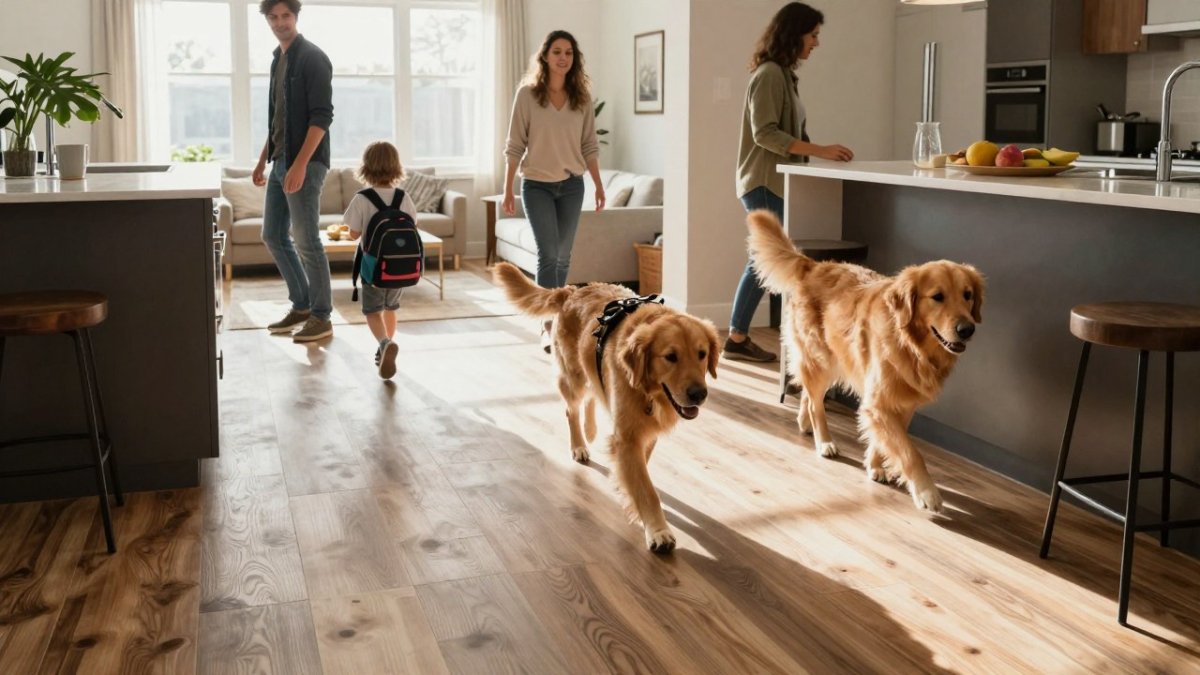
Flooring in a busy home or commercial space takes a daily beating. Choosing high traffic flooring starts with understanding what drives durability: the wear layer, the core, and how the material resists impact. Browse our flooring catalog to see any floor in a photo of your own room.
Wear layer thickness and scratch resistance
The wear layer is the clear top coating that protects the floor’s design layer from scuffs and scratches. A thicker wear layer generally means better scratch resistance and a longer working life.
A common mistake is assuming all vinyl plank performs the same. In practice, a thin wear layer in a hallway or entry can show scuffs within the first year, even when the product looks fine on the showroom floor.
Impact and dent resistance
Impact resistance matters most where heavy furniture, appliances, or dropped objects land. Rigid core products, such as stone plastic composite (SPC) and some engineered options, tend to resist indentation better than softer cores. Laminate, by contrast, can swell if water reaches the seams, so it needs more careful placement in wet or high-traffic zones.
Best Flooring for High-Traffic Areas and Pets
Pet owners and busy households need a floor that handles claws, accidents, and daily wear without constant upkeep. The right choice depends on the room, the moisture level, and how much weight the floor will carry.
Luxury vinyl plank and tile
Luxury vinyl plank (LVP) and luxury vinyl tile (LVT) are among the most practical choices for high traffic flooring. They are waterproof, relatively quiet underfoot, and available in wood and stone looks. Pet-friendly versions often include a thicker wear layer and a rigid core. Shop waterproof luxury vinyl plank and laminate built for humidity and pets.
Porcelain tile and natural stone
Porcelain tile is dense, fired at high temperature, and very resistant to moisture and staining. It holds up well under heavy foot traffic, but it is hard and unforgiving. Dropped glassware can break on it, and standing on it for long periods can be tiring. Natural stone such as granite or slate offers a distinctive look and strong durability, but it usually needs periodic sealing and can be more expensive to install.
Most Durable Flooring That Looks Like Wood
Many households want the warmth of hardwood without the upkeep. Wood-look options have improved considerably, and several hold up well in busy spaces.
Engineered hardwood uses a real wood veneer over a stable core, which makes it more resistant to moisture movement than solid hardwood. Its top layer can be refinished a limited number of times, depending on thickness.
Laminate, Engineered Hardwood and Carpet Tile Compared
Each material has trade-offs, and the best fit depends on the room.
| Material | Ideal para | Moisture Tolerance | Scratch and Dent Resistance | Typical Maintenance |
|---|---|---|---|---|
| Laminado | Bedrooms, living areas | De bajo a moderado | Good surface, weaker at seams | Sweep and damp-mop |
| Madera de ingeniería | Dry, formal rooms | Moderado | Good, varies by wear layer | Refinishing possible |
| Carpet tile | Offices, play areas, stairs | Bajo | Good for stains, tile replaceable | Spot clean, replace tiles |
| Piso vinílico de lujo | Kitchens, entries, pets | Alto | Good with thicker wear layer | Sweep and damp-mop |
Carpet tile deserves special mention for commercial and home-office use. Individual tiles can be swapped out when a section wears or stains, which keeps the overall floor looking consistent.
Commercial Grade Versus Residential Flooring Requirements
Commercial spaces face traffic levels that residential floors rarely see, and the difference shows up in how products are rated, warranted, and specified. Offices, clinics, schools, and retail spaces typically need products rated for heavier use, and the rating is the first thing to check before comparing price. Browse commercial LVT, modular carpet and tile for these spaces.
Reading the rating instead of the marketing label
Manufacturers publish use classifications and wear ratings that map a product to a traffic level. The two most common frameworks are:
- Residential-to-commercial use classes. Many vinyl and laminate products carry a class rating that runs from light residential use through heavy commercial use. A product rated for heavy commercial use is built for corridors, lobbies, and retail floors; a product rated for residential use is not, even if the marketing calls it “heavy duty.”
- Abrasion and wear ratings. Laminate and vinyl products often list an abrasion class or a wear-layer thickness in mils. Higher numbers generally mean better performance under grit and foot traffic, and the wear layer is the number to compare directly between products.
Ask for the specification sheet and confirm three things: the use classification, the wear-layer thickness or abrasion rating, and the warranty terms for the intended use.
Where residential products can and cannot go
Residential products can work in light-commercial settings such as a small office, a home-based studio, or a low-traffic reception area. A busy storefront, a clinic corridor, or a school hallway usually calls for commercial-rated material, because the traffic volume and cleaning schedule exceed what a residential warranty covers. Watch out: installing a residential-rated floor in a commercial space can void the warranty even when the product physically holds up, so confirm the warranty covers the type of use you expect before you buy.
Subfloor, moisture, and installation requirements
Commercial installations add requirements that residential projects often skip. Moisture testing of the concrete slab is standard before any glue-down installation, and the results determine which adhesive and moisture barrier are specified. Flatness tolerances are tighter for large-format tile and glue-down vinyl than for floating residential floors, and expansion gaps and transitions must be planned for the larger footprint.
Maintenance and cleaning schedules
Commercial floors are cleaned more often and with stronger equipment than residential floors. Confirm the product’s recommended cleaning method and the cleaning chemicals it tolerates, and check whether the warranty excludes damage from certain cleaners or from high-speed burnishing. A floor that performs well under residential cleaning can fail under a commercial janitorial schedule, so match the maintenance plan to the product before installation.
Life-Cycle Cost, Acoustics, Slip Resistance and Emissions
Most flooring comparisons stop at the purchase price. For a high-traffic area, the number that matters is the total cost of ownership over the floor’s service life: material, installation, maintenance supplies and labor, refinishing, and replacement. A cheaper floor that needs replacement in three years can cost more than a durable option that lasts a decade, and the gap widens fastest in entries, kitchens, and commercial corridors where wear concentrates.
Life-cycle cost: the four numbers to compare
Build a simple ten-year model for each candidate and compare four line items side by side:
- Installed cost per square foot. Material plus underlayment, adhesive, trim, and labor. Floating floors usually install faster than glue-down, which lowers labor.
- Annual maintenance cost. Sealed stone and grout need periodic resealing and grout cleaning; vinyl and laminate need only sweeping and damp mopping; carpet tile needs vacuuming and periodic deep cleaning.
- Refinishing and repair cost. Engineered hardwood can be refinished a limited number of times depending on veneer thickness; LVP and laminate cannot be refinished at all and are replaced plank by plank or tile by tile.
A mid-priced vinyl product with a thick wear layer can outlast a lower-priced laminate in busy households, because laminate seams can swell when exposed to moisture. Comparing only the shelf price per square foot can hide labor and maintenance differences that affect the long-term cost.
Acoustics: what STC and IIC actually measure
High-traffic areas are noisy, and hard surfaces reflect sound. Two ratings matter:
- STC (Sound Transmission Class) measures how well a floor assembly blocks airborne sound such as voices and television audio from passing between rooms.
- IIC (Impact Insulation Class) measures how well it blocks impact sound such as footsteps, dropped objects, and chair legs. Higher numbers mean better performance; building codes and HOA rules in multi-story buildings often set a minimum IIC for floor-ceiling assemblies.
Tile and stone on a hard subfloor score low on IIC and transmit footfall noise readily. Vinyl plank over an acoustic underlayment and carpet tile both raise IIC, which is why carpet tile remains common in offices and upper-floor corridors. If noise between floors is a concern, ask the manufacturer for the tested assembly’s STC and IIC values rather than the product’s standalone claim, because the underlayment and subfloor change the result.
Slip resistance: how COF is measured
Slip resistance is expressed as the coefficient of friction (COF), and the two standard test methods are the static coefficient of friction (SCOF) test and the tribometer-based dynamic test. A commonly cited threshold for level walking surfaces is a COF of 0.60 or higher, and many specifiers treat 0.60 as the floor for high-traffic wet areas. Glossy porcelain and polished stone can fall below that when wet; matte and textured finishes generally score higher.
Emissions and indoor air quality
Adhesives, underlayments, and finishes are the main sources of volatile organic compound (VOC) emissions in a new floor. Look for low-VOC adhesives and third-party certifications on the product and installation materials, and ventilate the space during and after installation. Floating installations that skip adhesive reduce the adhesive-related emissions, while glue-down installations should specify a low-VOC adhesive.
What Professional Flooring Installation Costs in 2026
Installation costs vary based on material, room size, subfloor condition, and labor rates in your area. Because pricing depends on quantity, timing, and delivery, we do not list fixed figures here.
Professional installation is worth considering for large areas, complex layouts, and any project where a warranty depends on proper installation. DIY installation can save labor costs for simple, floating floors, but subfloor preparation and proper acclimation are easy to get wrong.
Choosing Your High-Traffic Flooring With Viva Floors & More
Start by listing how each room is used, how much moisture it sees, and whether pets or children are part of the daily routine. Learn why this family-owned center is a trusted place to buy and install your floor.
Browse our flooring catalog to see a wide selection of flooring and countertop options from trusted brands.
Preguntas frecuentes
Is waterproof flooring good for pets?
Yes. Waterproof products such as luxury vinyl and SPC resist accidents and moisture, which makes them practical for pet owners.
Is engineered hardwood a good choice for high-traffic rooms?
It can be, in dry rooms with moderate traffic.
Preguntas frecuentes
What is the most durable flooring for high-traffic areas?
Porcelain tile and commercial-grade luxury vinyl plank rank among the most durable options for high-traffic areas. Porcelain resists scratches, moisture and heavy impact, and it holds its finish for decades with routine cleaning. Commercial-grade vinyl with a thick wear layer, typically 20 mil or more, handles constant foot traffic and pets well while staying softer underfoot. The right choice depends on the room, subfloor and how much comfort you want. Ask a flooring specialist to compare samples under your own lighting before you decide.
Is luxury vinyl plank better than laminate for high-traffic rooms?
In most high-traffic rooms, luxury vinyl plank performs better than laminate because it is highly moisture-resistant and its wear layer thickness is a key durability measure. Laminate can swell if liquids sit on the seams, which makes it a weaker choice in kitchens, entryways and rooms with pets. Laminate remains a budget-friendly option for lower-traffic spaces. Compare wear layer thickness and the warranty on each product before choosing.
What type of flooring is best for pets and high-traffic areas?
Luxury vinyl plank, porcelain tile and engineered hardwood with a durable factory finish are strong choices for homes with pets. Vinyl and tile resist claw marks and accidents, and they clean easily. Look for scratch-resistant surface treatments and a higher wear layer if you have large dogs. Carpet tile is another option for areas where softness and sound control matter more than stain resistance.
How do I choose flooring that resists scratches and heavy foot traffic?
Start with the wear layer rating, the clear protective top layer on vinyl and laminate products. A thicker wear layer resists scratches longer. For tile, the surface hardness and glaze matter more than thickness. Check impact and dent resistance ratings, and ask whether the product is rated for commercial use if the space sees heavy foot traffic. Testing a sample with sharp objects at home is a practical way to confirm performance.
