
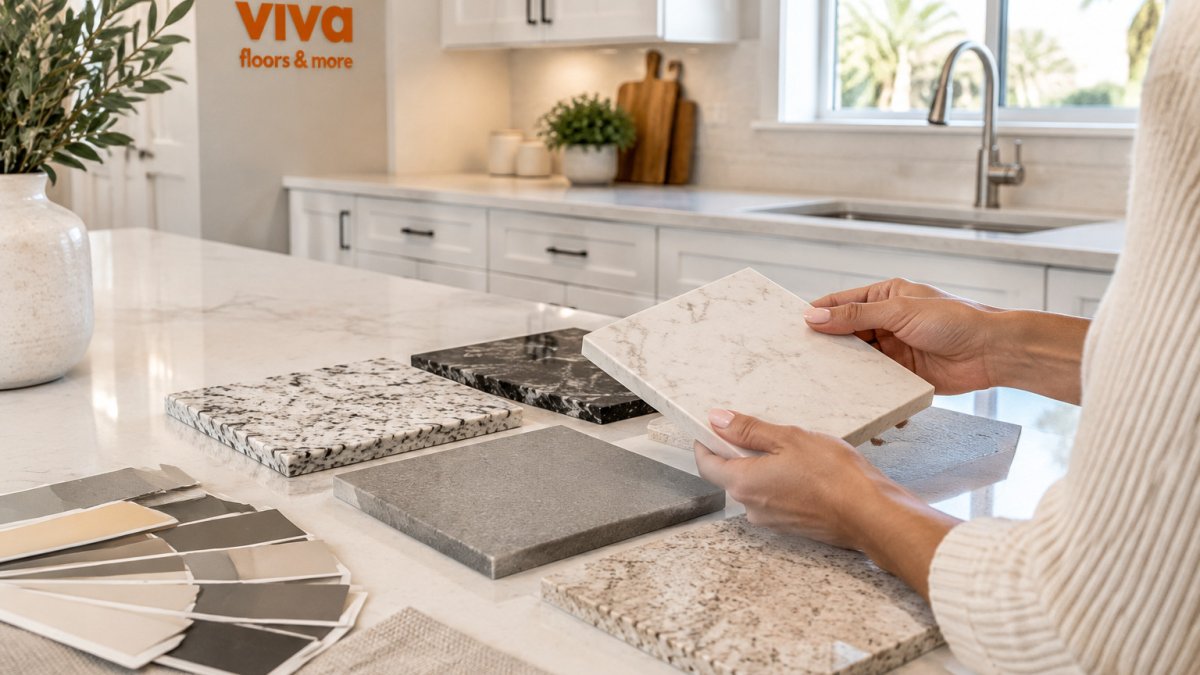
Quick Summary
To choose countertop colors for white cabinets, first identify whether the cabinets have a warm, cool, or neutral undertone, then pick a countertop that agrees with it. Compare samples directly on your cabinet door in daylight, since a mismatched undertone shows most in natural light.
- Hold plain white paper beside a cabinet door in indirect daylight to find its undertone.
- Warm cabinets suit cream, beige, or taupe countertops; cool cabinets suit white or light gray.
- Compare countertop samples in groups of three on the actual cabinet door.
- Test samples at home for several days in morning, afternoon, and evening light.
- Choose the countertop before the backsplash, then paint the walls last.
Table of Contents
- Why White Cabinets Need Careful Countertop Pairing
- Step 1: Identify the Undertone of Your White Cabinets
- Step 2: Decide Between Light or Dark Countertops With White Cabinets
- Step 3: Match Countertops to Your Floors, Including Gray and Wood
- Which Countertop Colors Go With White Cabinets and Wood Floors
- Step 4: Test Samples Under Your Own Lighting and Compare Quartz Options
- Step 5: Coordinate the Whole Room and Plan Your Budget
- Your Next Step: Bring Samples to Viva Floors & More
- Frequently Asked Questions
Why White Cabinets Need Careful Countertop Pairing
White cabinets look simple, but they are not neutral. For a fuller walkthrough of cabinet and countertop pairings, read the companion guide on the same topic. Every white has an undertone, and the countertop has to agree with it.
A common mistake is choosing the countertop first and the cabinets second. Reverse that order. Bring a cabinet door or paint chip to the countertop selection, then judge every sample against it.
Step 1: Identify the Undertone of Your White Cabinets
White cabinets are not a single color. Paint manufacturers formulate whites along a spectrum from warm (yellow, cream, or red base) to cool (blue, gray, or green base), with many labeled whites sitting in a neutral middle. The countertop has to agree with that undertone, or the mismatch shows up as a dull or dirty cast in daylight.
The paper-and-sample test
Start with a true-white reference. Hold a plain white sheet of paper or a white paint chip beside your cabinet door in indirect daylight, not under a warm bulb. Compare three things:
- Warm whites look yellow, cream, or slightly pink next to the paper. Common examples include whites described as alabaster, cream, or linen.
- Cool whites look crisp with a faint blue or gray cast next to the paper. Whites described as extra white, icy, or pure often fall here.
- Neutral whites look close to the paper with no obvious cast. These give you the most flexibility.
Do the test on an actual cabinet door or a painted sample, not on a small paint chip alone. A chip can read neutral while a full door reads warm because the larger surface reflects more of the room.
Build a three-sample comparison
Once you know the cabinet undertone, compare countertop samples in groups of three rather than one at a time. A common pattern is to place one warm-leaning sample, one cool-leaning sample, and one neutral sample directly on the cabinet door. This forces a side-by-side judgment and makes a clash obvious.
- If your cabinets are warm, a warm-leaning countertop (cream, beige, taupe, or a stone with gold or brown veining) will echo the cabinets. A cool gray or blue-veined stone will fight them.
- If your cabinets are cool, a cool-leaning countertop (white, light gray, or a stone with gray or blue veining) will look clean. A yellow-based cream will make the cabinets look dingy.
- If your cabinets are neutral, you can go either direction, but pick one and repeat it in the backsplash and floor so the room reads intentional.
Check the countertop’s own undertone
Countertops have undertones too, and they are not always obvious from a small sample. A gray quartz can lean warm (brownish gray) or cool (blue-gray). A white marble can lean warm (cream background) or cool (bright white background). Ask for a larger sample or view a full slab when the pattern matters, because veining and background color shift across a slab.
Watch out: a countertop that looks neutral in the showroom can read warm or cool once it is installed against your cabinets, so never skip the in-kitchen sample step in Step 4.
What to do with a strong undertone
If your cabinets have a strong warm or cool cast, you have two safe moves. Echo the undertone for a cohesive look, or choose a true neutral countertop that sits between the cabinet and the floor. Avoid choosing a countertop with the opposite strong undertone unless you are deliberately creating contrast and repeating that contrast elsewhere in the room.
Matching the countertop to your cabinets starts with their undertone, which you can compare directly.
| Cabinet undertone | Look next to plain white paper | Countertop to consider |
|---|---|---|
| Warm | Yellow, cream, or slightly pink | Cream, beige, taupe, or gold or brown veining |
| Cool | Crisp, with a faint blue or gray cast | White, light gray, or gray or blue veining |
| Neutral | Close to the paper, no obvious cast | Either direction, then repeat it in backsplash and floor |
Step 2: Decide Between Light or Dark Countertops With White Cabinets
This is the central choice. Light countertops create a soft, airy kitchen. Dark countertops create contrast that makes the white cabinets look brighter.
When Light Countertops Work Best
Light countertops suit small kitchens, rooms with limited natural light, and buyers who want a subtle, cohesive look. White, cream, and light gray stone keep the whole room feeling open.
Watch the veining. Soft gray veining in a light stone blends well. Heavy black veining can look busy against white cabinets. If you are weighing marble’s upkeep trade-offs as a light countertop, read the marble upkeep article first.
When Dark Countertops Create Contrast
Dark countertops, such as black, charcoal, or deep espresso tones, give white cabinets a crisp frame. They work well in larger kitchens with good lighting, where the contrast reads as intentional rather than heavy.
The trade-off is visibility. Dark surfaces show dust, water spots, and crumbs more readily, so choose a finish that hides marks if you cook daily.
Step 3: Match Countertops to Your Floors, Including Gray and Wood
Your flooring affects how the countertop reads. Gray floors pair well with cool white cabinets and light gray or white counters. Wood floors add warmth, so a warm white cabinet and a cream or beige countertop often look best.
Check the floor and the countertop side by side. A cool gray counter over a warm honey-toned floor can look mismatched even when each finish looks fine alone.
Which Countertop Colors Go With White Cabinets and Wood Floors
With medium to dark wood floors, these combinations tend to work:
- Warm white cabinets with cream or beige quartz: a soft, traditional look
- Bright white cabinets with white or light gray stone: a clean, modern look
- Off-white cabinets with taupe or greige counters: a transitional look that ties to wood tones
- White cabinets with black or dark charcoal counters: high contrast, works best over lighter wood
Step 4: Test Samples Under Your Own Lighting and Compare Quartz Options
Showroom lighting is not your kitchen’s lighting. Take sample slabs home and set them on the actual cabinets for several days. Look at them in morning light, afternoon light, and under the kitchen lights you will use at night.
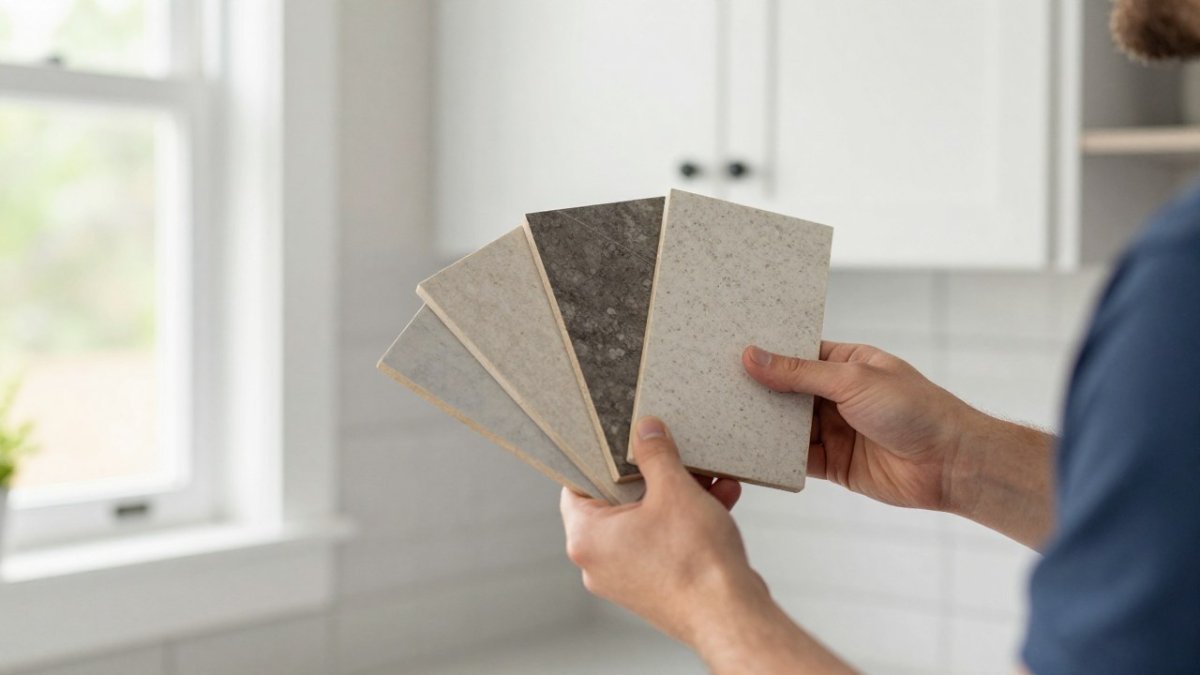
Compare several quartz lines, and ask for a larger sample when a pattern matters. If you are weighing a natural stone, see our guide on how to seal natural stone countertops to understand the upkeep before you commit. Step-by-step sealing instructions cover the water test through cure time.
Step 5: Coordinate the Whole Room and Plan Your Budget
A countertop that looks right on its own can still fail once the backsplash, floor, hardware, and appliances are in the room. Treat the kitchen as one palette and choose in a fixed order so each decision constrains the next instead of fighting it.
A whole-room coordination workflow
Use this order to keep the palette coherent:
- Lock the fixed elements first. Flooring, appliances, and any existing tile are the hardest and most expensive to change. Note their undertone and dominant color before you shop for countertops.
- Choose the countertop next. It is the largest visual surface after the cabinets and sets the room’s temperature. Bring your cabinet door and a floor sample to the slab yard.
- Pick the backsplash to support the countertop. A backsplash should either match the countertop’s background or repeat a secondary tone from the countertop or floor. A bold tile can work, but only if the countertop is quiet.
- Choose wall paint last. Paint is the cheapest element to change, so it should bend to the countertop and backsplash, not the other way around.
- Repeat two or three tones. Limit the room to two or three main tones (for example, white cabinets, warm gray countertop, and wood floor) and repeat each one at least twice. Hardware and lighting finish the palette but should not introduce a new dominant color.
Watch out: choosing a bold backsplash before the countertop is settled is the most common way a white-cabinet kitchen ends up looking disjointed, because the backsplash locks in a color the countertop then has to match.
Material performance and maintenance
Color is only half the decision. The surface has to survive daily cooking, and the common materials trade off differently:
- Quartz is engineered and non-porous, so it resists stains and does not need sealing. It is consistent from slab to slab, which makes color matching easier. It is less heat-tolerant than stone, so use trivets under hot pans.
- Granite is natural and porous, so it needs periodic sealing. It tolerates heat well and resists scratches, but pattern and color vary by slab, so you must approve the actual slab.
- Marble is softer and porous, so it stains and etches more readily and needs sealing and careful upkeep. It offers the most distinctive veining.
- Soapstone and other natural stones vary in hardness and porosity, so ask about sealing and heat tolerance before committing.
Budget and installed cost
Countertop cost is driven by more than the material name. Common cost drivers include:
- Edge profile. A simple eased edge costs less than a detailed profile that requires more fabrication time.
- Fabrication. Cutouts for sinks and cooktops, seam placement, and complex shapes add labor.
- Installation. Stairs, tight access, and removal of old countertops add cost.
Ask for a written estimate that breaks out material, fabrication, edge profile, and installation separately. To plan the room’s budget, you can estimate what installing granite countertops will cost. For current pricing, request a quote from Viva Floors & More, since pricing depends on quantity, timing, and slab availability. A written estimate also lets you compare bids on the same scope instead of on the headline number.
Your Next Step: Bring Samples to Viva Floors & More
Choosing countertop colors for white cabinets is easier when you can see real slabs next to your cabinets. Visit the Viva Floors & More showrooms in Pharr or Brownsville, bring a cabinet door or paint chip, and compare samples in the light you will live with. Our team can help you narrow the options and request a current estimate for your project.
Last Updated: November 19, 2026
Frequently Asked Questions
What color countertop would look best with white cabinets?
Warm white, cream, greige, and soft gray tones tend to pair well with white cabinets because they add contrast without clashing. Match the undertone of your cabinets first: warm cabinets usually look best with warm countertops, and cool white cabinets often suit cool gray or white quartz. Always compare full-size samples next to your actual cabinet doors in the room where the kitchen gets its main light, because colors shift noticeably between showroom lighting and home lighting.
Should a countertop be lighter or darker than white cabinets?
Either works, but the choice changes the look. Lighter countertops create a bright, seamless kitchen with less visual break between surfaces. Darker countertops, such as charcoal or black-toned quartz, add contrast and make white cabinets stand out. If your floors are dark, a lighter countertop can keep the kitchen from feeling heavy, while medium or dark floors often balance a darker countertop well.
What countertop colors work with white cabinets and gray floors?
Gray floors usually pair well with white or light gray countertops, which keep the palette cohesive, or with warm beige and greige for a softer transition. Avoid cool blue-gray countertops if your floors have a warm gray tone, since the mismatch can look unintentional. Bring a floor sample to your showroom visit and place it next to the countertop sample to check the undertones together.
Are quartz countertops a good choice for white cabinets?
Quartz is a common choice for white cabinets, and it is available in a range of colors and patterns. Ask about stain resistance and maintenance requirements for the specific product you are considering, since performance varies by brand and finish.
