Last Updated: November 22, 2026
Quick Summary
Eco-friendly flooring for large scale renovations should be chosen on durability under traffic, lifecycle cost, supply reliability, and documented sustainability claims. Materials with the longest service life, such as porcelain tile, terrazzo, and recycled rubber, tend to score best on lifecycle sustainability even at higher upfront cost.
- Bamboo, cork, and reclaimed wood share one advantage: their raw material regenerates or already exists.
- Porcelain, ceramic, and stone tile deliver the longest service life on the material list.
- Recycled rubber, terrazzo with recycled aggregate, and recycled-content tile are the most practical recycled options.
- Specify water-based finishes, low-VOC adhesives, and mechanical fastening to limit installation emissions.
- Order all material in one production run to avoid visible batch mismatch across a large floor.
Table of Contents
- Eco-Friendly Flooring Options for Large Scale Renovations: A Decision Framework
- What Makes Flooring Sustainable
- The Comparison Table: Durability, Cost, and Sustainability Rating
- Bamboo, Cork, and Reclaimed Wood: Renewable and Reclaimed Materials
- Tile, Porcelain, and Stone: Durable Eco-Friendly Flooring for High-Traffic Areas
- Recycled Flooring Options: Rubber, Terrazzo, and Recycled-Content Tile
- Non-Toxic Flooring Options: Low-VOC Finishes, Adhesives, and Indoor Air Quality
- Sustainable Commercial Flooring: Performance by Room and Building Use
- Planning a Large Renovation: Phased Installation, Lifecycle Cost, and Supply-Chain Logistics
- Requesting a Flooring Estimate for Your Renovation
- Frequently Asked Questions
Eco-Friendly Flooring Options for Large Scale Renovations: A Decision Framework
Eco-friendly flooring is any floor covering whose sourcing, manufacturing, installation, and end-of-life path reduce environmental impact versus conventional alternatives.
The stakes are higher than a single-room remodel: a floor specified for a school corridor or lease space must survive a decade of use, arrive on schedule, and meet the owner’s environmental standard.
Below, we break down each material family, compare them on durability and lifecycle cost, and explain how to phase a large installation without stalling the rest of the build.
What Makes Flooring Sustainable
A flooring product earns the sustainable label through five measurable traits: renewable or recycled sourcing, low-VOC emissions, durability, recyclability or reuse at end of life, and responsible manufacturing. No single material wins on all five.
The trap is treating “natural” as a synonym for “sustainable.” Rapidly renewable bamboo still carries a carbon footprint from shipping and finishing; recycled-content tile still needs energy to fire.
Ask for the sourcing story, emissions data, and expected service life.
The Comparison Table: Durability, Cost, and Sustainability Rating
Here is how the main material families stack up for large projects. Pricing depends on quantity, specification, and delivery. For current prices or a quote, contact Viva Floors & More directly.
| Material | Durability | Relative Cost | Sustainability Rating | Best For |
|---|---|---|---|---|
| Bamboo | High (strand-woven) | Mid | Strong (renewable) | Residential, light commercial |
| Cork | Moderate | Mid | Strong (renewable, low-VOC) | Bedrooms, offices, sound control |
| Reclaimed wood | High | High | Strong (reuse) | Feature areas, lobbies |
| Porcelain tile | Very high | Mid to high | Good (long life) | High-traffic commercial |
| Natural stone | Very high | High | Good (long life) | Entrances, hospitality |
| Rubber (recycled) | Very high | Mid | Strong (recycled content) | Gyms, clinics, back-of-house |
| Terrazzo | Very high | High | Good (recycled aggregate) | Lobbies, schools, retail |
| Linoleum | Moderate to high | Mid | Strong (natural materials) | Kitchens, classrooms |
The pattern: materials with the longest service life tend to score best on lifecycle sustainability, even at higher upfront cost.
Bamboo, Cork, and Reclaimed Wood: Renewable and Reclaimed Materials
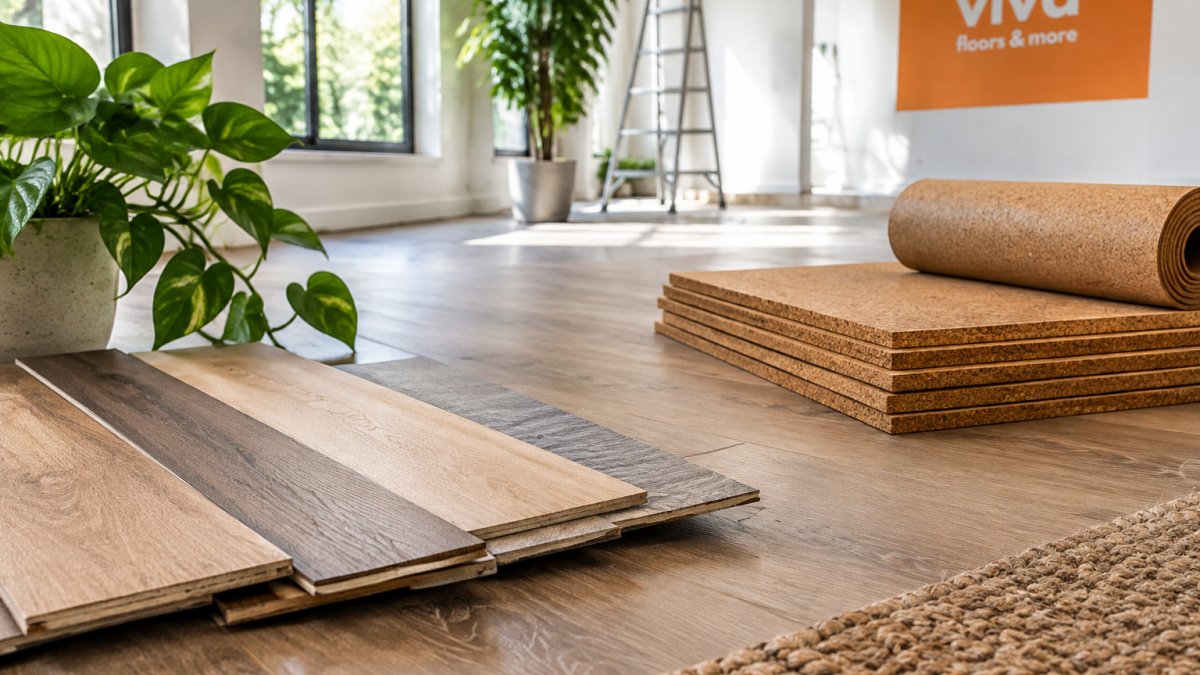
Bamboo, cork, and reclaimed wood share one advantage: their raw material regenerates or already exists.
Cork is often chosen for offices, clinics, and bedrooms where sound control matters.
Reclaimed wood is the strongest sustainability story here and the hardest to scale, sourcing enough matching material for a large renovation is a real constraint.
Best for: residential renovations and light commercial spaces with humidity control.
Skip if: the space sees standing water or heavy rolling loads.
Tile, Porcelain, and Stone: Durable Eco-Friendly Flooring for High-Traffic Areas
Porcelain, ceramic, and stone tile deliver the longest service life on this list, which is why they anchor most sustainable commercial flooring specifications.
Porcelain is generally denser than ceramic, which is why it is often specified for corridors, restrooms, and entries.
Tile costs more to install than resilient flooring, and that cost scales with square footage. Budget for substrate prep, since large-format tile demands a flat, stable subfloor.
For a deeper comparison of wear layers and upkeep across busy rooms, our guide on how to pick the best flooring for high traffic areas walks through the decision. If you want to see the actual tile lines available, browse our tile flooring selection for floors, showers, and patios.
Recycled Flooring Options: Rubber, Terrazzo, and Recycled-Content Tile
Recycled flooring options turn post-consumer and post-industrial waste into a durable surface.
Recycled rubber flooring is often used in gyms, clinics, and back-of-house areas.
Terrazzo binds chips of marble, glass, or other recycled aggregate in a cement or resin matrix.
Recycled-content tile is made with recycled material in place of some virgin material. Ask for the recycled content percentage in writing, since claims vary widely between products.
Non-Toxic Flooring Options: Low-VOC Finishes, Adhesives, and Indoor Air Quality
Non-toxic flooring options are products and installation systems that minimize volatile organic compound emissions, protecting indoor air quality during and after installation.
Indoor air quality matters most in schools, clinics, and occupied buildings where installation happens around people. Specify water-based finishes, low-VOC adhesives, and mechanical fastening where the product allows. Prefinished products avoid on-site finishing emissions entirely, which is why they dominate large commercial specifications.
Low-VOC Flooring: What the Labels Actually Mean
Low-VOC flooring refers to products whose emissions fall below defined thresholds, but thresholds differ by program, a “low-VOC” claim without a named standard is marketing.
Common programs you’ll encounter on flooring documentation include:
- FloorScore, an indoor-air quality certification for hard surface flooring and adhesives, administered under a third-party program and widely referenced in commercial specifications.
- GREENGUARD and GREENGUARD Gold, emissions certifications with a stricter Gold tier intended for sensitive environments such as schools and healthcare.
- CDPH Standard Method (Section 01350), a California indoor-air emissions standard frequently cited in specifications and used as the basis for many product certifications.
- Cradle to Cradle, a multi-attribute certification that covers material health, recyclability, and social fairness, not emissions alone.
Three practical checks before you accept a claim:
- Confirm the specific certification and the emissions limit it enforces, and check that the certificate covers the product you’re buying rather than a sibling product line.
- Ask whether the adhesive, underlayment, and finish carry the same certification as the floor. A common mistake is certifying the plank and ignoring the adhesive.
- Request the manufacturer’s documentation for the exact product run, including the EPD or ingredient disclosure where available, and keep it in the project file so the claim is defensible after occupancy.
Watch out: a certificate that names the manufacturer but not the specific SKU is not proof for your product, ask for the product-level listing, because certifications are frequently issued per product line and per manufacturing site.
Verifying Environmental Claims Across the Specification
The same evidence discipline applies to the broader sustainability claims in this guide. Renewable sourcing, recycled content, and end-of-life recyclability should each be backed by documentation, not adjectives.
Sustainable Commercial Flooring: Performance by Room and Building Use
Sustainable commercial flooring works when the material matches the room’s actual demands. A single floor type across an entire building usually means over-specifying some spaces and under-specifying others.
Match material to use:
- Entries and corridors: porcelain tile or terrazzo for wear and moisture resistance
- Offices and clinics: cork, linoleum, or carpet tile for acoustics and comfort
- Gyms and back-of-house: recycled rubber for impact and durability
- Restrooms and utility rooms: porcelain tile for water resistance and easy sanitation
For projects covering multiple buildings or large lease spaces, our commercial flooring products with volume pricing cover offices, clinics, schools, banks, and lease spaces.
Planning a Large Renovation: Phased Installation, Lifecycle Cost, and Supply-Chain Logistics
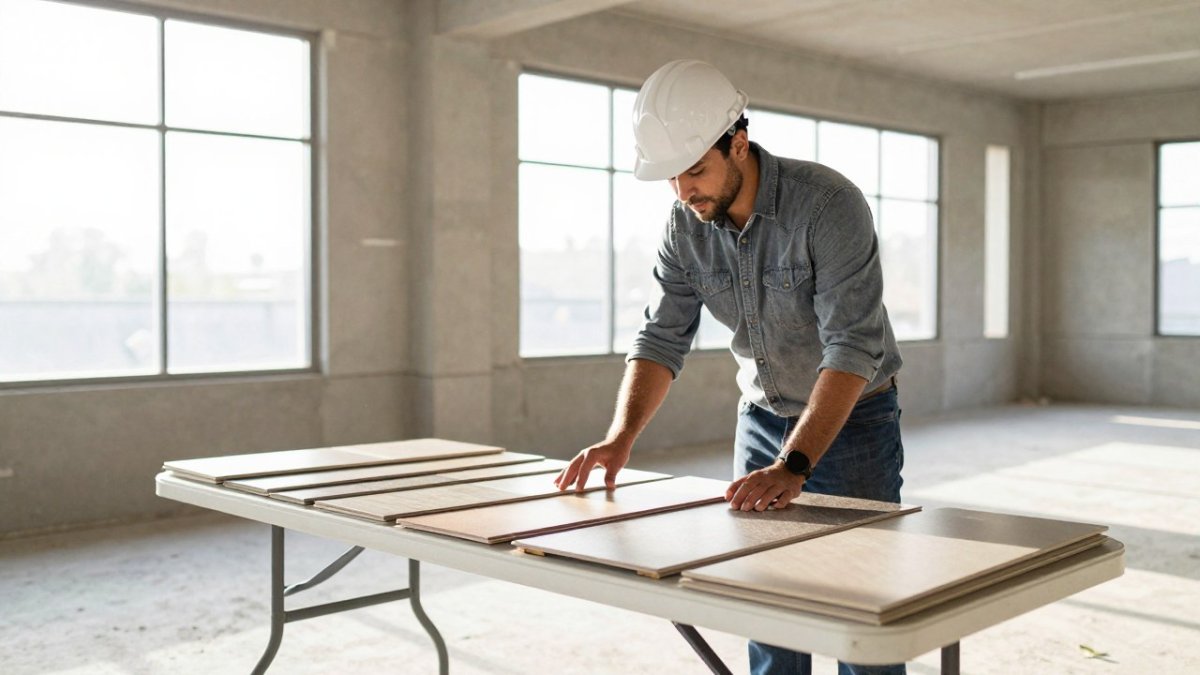
Large renovations fail on logistics more often than on material choice. A specification that looks perfect on a sample board can still stall a project if the material arrives in mismatched dye lots, if the subfloor can’t accept it, or if removal and disposal of the existing floor wasn’t scoped. Three planning disciplines separate a smooth project from a stalled one: phasing and sequencing, lifecycle cost analysis, and supply verification.
Phasing and Installation Sequencing
Phase installation by zone so occupied areas stay functional and each trade finishes before the next begins. Sequence from the least-occupied zones toward the most-occupied, keeping a protected path open for building users.
Order all material for the project in one production run where possible. Dye lots, caliper, and shade vary between runs, and a second run ordered mid-project is the most common cause of visible batch mismatch across a large continuous floor.
Whole-Life Cost and Lifecycle Assessment
Whole-life cost compares materials over their full service life, not just the purchase price.
Build a lifecycle comparison on a consistent basis: purchase cost per square foot, installation including substrate prep, expected service life, annual maintenance, replacement cost, and end-of-life disposal or diversion cost.
A lifecycle framework also lets you defend a higher upfront specification in language owners already use for HVAC and roofing decisions.
Supply-Chain and Commercial-Scale Constraints
Large projects stress the supply chain in ways single-room work does not. Address these before specification is final:
- Minimum order quantities and run consistency. Confirm the manufacturer can supply the full area from a single production run, and get the batch or lot number on the purchase order.
- Regional sourcing and freight. Domestic or regional manufacturing shortens lead time and reduces freight distance, which matters both for schedule and for the transportation share of the product’s carbon footprint.
- Specification continuity. If a product is discontinued mid-project, a matching replacement may not exist. Ask about the manufacturer’s stated availability horizon and whether a successor product is specified.
- Storage and acclimation. Many products need on-site acclimation before installation; plan conditioned storage so a delivery doesn’t sit in an uncontrolled space and fail at install.
Installation Emissions and Renovation Waste
Installation emissions and demolition waste are environmental costs that specifications should account for. Adhesives, finishes, and sealants release VOCs during install. Old flooring removed during renovation becomes waste unless it’s diverted.
Reduce both by specifying prefinished products, water-based adhesives, and mechanical fastening where the product allows.
Requesting a Flooring Estimate for Your Renovation
A flooring estimate for a large renovation should cover material, installation, substrate prep, and phasing, not just a square-foot price. Get the scope in writing before you commit.
Here’s a checklist to bring to your estimate:
- Total square footage by room or zone
- Subfloor condition and prep needs
- Material specification with certification documentation
- Adhesive and finish specification
A professional consultation can help with measurements and material selection. You can read about the benefits of a professional flooring consultation before you request an estimate. When you’re ready, contact our team to schedule your estimate.
Large renovations reward planning over speed. The material that looks greenest on the box isn’t always the one that performs for two decades.
Frequently Asked Questions
Which eco-friendly flooring is best for a large-scale renovation?
The best choice depends on room use, budget, and maintenance capacity. For high-traffic commercial spaces, porcelain tile and terrazzo offer decades of lifespan with minimal replacement. For residential projects, bamboo and cork provide renewable materials with warm underfoot comfort. Reclaimed wood adds character but requires more sourcing lead time.
What flooring materials have low VOC emissions?
Low-VOC flooring includes natural linoleum, cork, bamboo with water-based finishes, porcelain tile, and recycled-content rubber. Look for third-party certifications like FloorScore or Greenguard Gold on the product documentation. Adhesives and sealants matter as much as the plank or tile itself, so specify low-VOC installation products.
Is recycled flooring durable enough for high-traffic spaces?
Yes, when specified correctly. Recycled rubber flooring is used in commercial gyms and retail entries, and terrazzo made with recycled glass chips is a durable option. Check the PEI rating for tile and the wear layer for resilient products. For a large renovation, request sample squares and test them under rolling loads before finalizing the order.
How do you compare the environmental impact of flooring materials?
Compare four factors: material sourcing (renewable versus finite), embodied carbon from manufacturing and transport, indoor air quality emissions, and end-of-life pathways like recyclability or biodegradability. Request Environmental Product Declarations (EPDs) and look for Cradle to Cradle certification where available. A lifecycle assessment that includes replacement cycles can help compare durable materials against shorter-lived options.
